Free Ebook Spacesuit: Fashioning Apollo (MIT Press), by Nicholas de Monchaux
Spacesuit: Fashioning Apollo (MIT Press), By Nicholas De Monchaux. Exactly what are you doing when having downtime? Chatting or scanning? Why do not you aim to check out some e-book? Why should be reviewing? Reviewing is one of enjoyable and pleasurable activity to do in your extra time. By checking out from numerous resources, you could find new info and encounter. The publications Spacesuit: Fashioning Apollo (MIT Press), By Nicholas De Monchaux to check out will certainly many starting from scientific publications to the fiction e-books. It indicates that you could review the publications based upon the need that you desire to take. Obviously, it will certainly be different as well as you can read all e-book kinds any kind of time. As right here, we will certainly reveal you a publication ought to be read. This publication Spacesuit: Fashioning Apollo (MIT Press), By Nicholas De Monchaux is the selection.
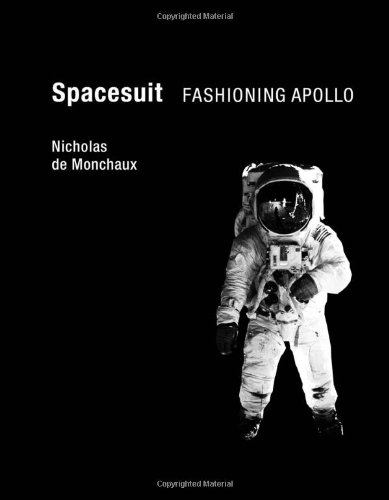
Spacesuit: Fashioning Apollo (MIT Press), by Nicholas de Monchaux

Free Ebook Spacesuit: Fashioning Apollo (MIT Press), by Nicholas de Monchaux
When you are hurried of task deadline and have no idea to get inspiration, Spacesuit: Fashioning Apollo (MIT Press), By Nicholas De Monchaux book is among your options to take. Reserve Spacesuit: Fashioning Apollo (MIT Press), By Nicholas De Monchaux will certainly offer you the best resource as well as point to obtain motivations. It is not only about the jobs for politic business, management, economics, and various other. Some ordered works to make some fiction your jobs additionally require inspirations to get over the task. As just what you require, this Spacesuit: Fashioning Apollo (MIT Press), By Nicholas De Monchaux will probably be your selection.
This publication Spacesuit: Fashioning Apollo (MIT Press), By Nicholas De Monchaux deals you better of life that can create the high quality of the life better. This Spacesuit: Fashioning Apollo (MIT Press), By Nicholas De Monchaux is just what the people now need. You are right here as well as you might be exact and sure to get this publication Spacesuit: Fashioning Apollo (MIT Press), By Nicholas De Monchaux Never question to obtain it even this is simply a publication. You could get this publication Spacesuit: Fashioning Apollo (MIT Press), By Nicholas De Monchaux as one of your compilations. Yet, not the compilation to present in your shelfs. This is a valuable publication to be reviewing collection.
How is making sure that this Spacesuit: Fashioning Apollo (MIT Press), By Nicholas De Monchaux will not displayed in your bookshelves? This is a soft documents publication Spacesuit: Fashioning Apollo (MIT Press), By Nicholas De Monchaux, so you can download and install Spacesuit: Fashioning Apollo (MIT Press), By Nicholas De Monchaux by purchasing to obtain the soft file. It will certainly alleviate you to review it whenever you need. When you really feel careless to relocate the published publication from the home of office to some location, this soft data will reduce you not to do that. Since you can only conserve the data in your computer unit and gadget. So, it allows you read it almost everywhere you have willingness to check out Spacesuit: Fashioning Apollo (MIT Press), By Nicholas De Monchaux
Well, when else will certainly you locate this prospect to obtain this publication Spacesuit: Fashioning Apollo (MIT Press), By Nicholas De Monchaux soft file? This is your good chance to be right here and get this great publication Spacesuit: Fashioning Apollo (MIT Press), By Nicholas De Monchaux Never leave this book before downloading this soft documents of Spacesuit: Fashioning Apollo (MIT Press), By Nicholas De Monchaux in link that we provide. Spacesuit: Fashioning Apollo (MIT Press), By Nicholas De Monchaux will truly make a great deal to be your buddy in your lonely. It will certainly be the most effective partner to improve your business and leisure activity.
How the twenty-one-layer Apollo spacesuit, made by Playtex, was a triumph of intimacy over engineering.
- Sales Rank: #549134 in Books
- Brand: MIT Press
- Published on: 2011-03-18
- Ingredients: Example Ingredients
- Original language: English
- Number of items: 1
- Dimensions: 9.00" h x .90" w x 7.00" l, 2.52 pounds
- Binding: Paperback
- 380 pages
- MIT Press MA
Review
The most delightful and memorable new book I read last year...
– Adam Gopnik, THE NEW YORKER.COM
The density of ideas and connections is intoxicating. De Monchaux swings masterfully between subjects, teasing out unexpected connections and spotting the seeds of contemporary life that were planted by the space race.
– ICON (UK)
[a] wonderful material history...
– LOS ANGELES REVIEW OF BOOKS
... a broad and creative appraisal of [the] suit's many contexts, encouraging readers to consider technology as design, shaped by the circumstances of its time, unfailingly and elegantly layered and crafted to serve a purpose.
– NATURE
... now the definitive investigation of this terrain.
– THE ATLANTIC.COM
"Berkeley architecture professor de Monchaux's thorough and artful history of the American spacesuit takes readers at a leisurely pace through the past...a wholly absorbing capsule of our history. "
- PUBLISHER'S WEEKLY, Starred Review
Woven, as befits its topic, with multiple and colored threads borrowed from an astounding variety of fields and domains--technology, politics, media, and fashion design, to name only a few--this path-breaking book provides an innovative reading of the space race. Above all, it illuminates the relevance of this race for designers from yesterday and today.
– ANTOINE PICON, Travelstead Professor of the History of Architecture and Technology, Harvard Graduate School of Design
…This surely is one of the most deeply researched books on design ever written.
– RALPH CAPLAN, author of _By Design: Why There Are No Locks on the Bathroom Doors in the Hotel Louis XIV and Other Object Lessons
de Monchaux offers in this remarkable book a far-reaching and broad-based analysis of the spacesuit, interpreting it as far more than a functional garment protecting astronauts but also as an artifact at the nexus of society, science, and spacefaring...
– ROGER LAUNIUS, Senior Curator, Smithsonian National Air and Space Museum
About the Author
Nicholas de Monchaux is Assistant Professor of Architecture at the College of Environmental Design, University of California, Berkeley. His work has appeared in the architectural journal Log, the New York Times, the New York Times Magazine, Architectural Design, and other publications.
Most helpful customer reviews
14 of 14 people found the following review helpful.
Five Stars*****
By Houston Reader
Physically, "Fashioning Apollo" is quite an elegant book (even though it is soft-bound with a "rubberized" dust cover). Text and photos are all of superb quality, glossy throughout; and it has a nice smell to it (something you'll never get from a Kindle).
If you're looking for a nuts and bolts technical book, this isn't the book for you. There are several other excellent texts that fit that bill. This is more of a series of essays on a variety of subjects, not always directly related to the spacesuit, but somehow always returning. In some ways, it reminds me of "Of a Fire on the Moon" by Normal Mailer - more of a "feeling" than simply straight reportage.
I wasn't quite sure what to expect, but overall, I think it's a great book. It takes a variety of historical viewpoints, ranging from Dior fashions, to the detonation of the first hydrogen bomb, to the shocking state of JFK's health, to the fact that Wylie Post's eyepatch helped warm the icy oxygen that was pumped into his first altitude suit, and manages to pull them all together into a very well-written book.
Any shortcomings would be related to its intended audience: it doesn't seem "technical" enough to satisfy the space-geek-types, but there is not a huge pool of 'non-geeks' who are likely to be interested in this sort of thing. Having said that, "Fashioning Apollo" appears to have been well-researched, Mr. de Manchaux is obviously an accomplished writer, and I highly recommend this book.
16 of 16 people found the following review helpful.
International Latex Corporation's A7L
By Dave English
A beautiful bountiful book. This is a high quality look at the design (and what that design means to us in other contexts) of the Apollo spacesuit. It covers a lot of ground, engineered as the suits were, with handcrafted layers that perform many different yet interrelated functions. So we have chapters on the actual construction of the suit, and chapters on cities and simulation and JFK. It's sometimes wordy, is not afraid of big concepts, but it is always lively. A flexible mix of human and technical interactions. The point is that unlike most of the other systems that got us to the moon, a space suit is best fashioned to the evolved biological complexity of the human body, a second skin, rather than an engineered off-the-shelf hard shell.
We are treated to a smart romp that deftly combines fashion, politics, ergonomics, space travel, architecture, history, corporate culture and an iconic journey to the brave new frontier. There are lots of books on the Apollo moon missions, but however many you have this will be a unique addition to the understanding of how we got to make that first step on another world. Wonderfully illustrated, fully referenced. I hope you find this review helpful.
35 of 37 people found the following review helpful.
Top notch - offers a parallax view for space cadets
By Fairleigh Brooks
As a certified space cadet I have read dozens of books about the history of space exploration and manned space flight, many more on aviation and astronomy. (I own a book, for example, called "Eject! The Complete History of U.S. Aircraft Escape Systems. Actually, it's pretty interesting.)
Virtually all of these books, excepting Mailer's "Of a Fire on the Moon," of course, were written by the anointed for the choir. They focus narrowly, or not too broadly, anyway, on a specific subject and the straightforward tangents of that subject. Michael de Monchaux's "Spacesuit - Fashioning Apollo" was not written for this audience, and the difference is compelling and fascinating. De Monchaux is Assistant Professor of Architecture at the College of Environmental Design at UC Berkeley.
Put succinctly, "Spacesuit - Fashioning Apollo" is the history of the spacesuit as a technology, specifically the Apollo spacesuit. To anyone who has explored the history of any technology - the photocopier, cell phone towers, bar codes, VCRs, etc., etc. - the gist that emerges quickly and throughout is how far back in time are the beginnings, and how divergent are the seminal paths that eventually merge to create this new thing. The beginnings of the Apollo spacesuit reach back to a Russian Jewish immigrant born in 1901, Abram Spanel. Spanel started the International Latex Corporation (ILC), better known as Playtex. Yep, the spacesuits that allowed moon-walking astronauts to survive were made by master seamstresses who had once made bras and girdles. Just imagine how this went over with the fighter jock personalities at NASA.
But moreover, this book is a cultural treatise about clothing the human body. NASA basically did not want the suit ILC proposed, which was an actual garment. Most in NASA and the aerospace industry wanted to contain astronauts in hard, rigid suits (cans, really), not dress them in fabric. And yet, once all requirements were considered, ILC's concepts were chosen.
Rather than simply dissect how the Apollo spacesuit came to be, de Monchaux explores a spectrum of cultural powers and movements that made such a device possible, but not necessarily inevitable. The narrative explains that the only way to develop a spacesuit that worked fully was to maintain the round peg of the human body as the square-hole concepts of engineering and bureaucracy evolved to accommodate that concept. The concepts for rigid suits came up short. Regarding Apollo, they came up short rather completely.
This book is also an expose of the Cold War. Informed and inquisitive people have always known there were activities our democracy pursued that were far removed from our consuming, post-war suburban lives of ease and abundance. Even for the well educated, though, that knowledge tended to be cursory without the specific pursuit of a particular interest. Presented here both explicitly and implicitly is a window into the myriad of secret (or at least never publicized) programs, as well as the almost open-ended funding that paid for them.
Further, this books is about The Sixties, perhaps the most American decade in a century that was already America's. As de Monchaux tells the story, the Apollo suit is really emblematic of a conterculture. ILC's informal engineers were self taught, with little if any college experience, details that rankled the quantitative, degree-strewn POV of NASA and aerospace bureaucracies. Although from a generation well before Woodstock, ILC engineers found implicitness out of explicitness, while also finding ways to satisfy the calculations and methodologies the bureaucracies needed as much as demanded.
There is no doubt the initial purpose of Apollo, in 1961, was political, both domestically and internationally. As de Monchaux writes, "From the perspective of Kennedy's knowledge of the media's power in the cold war, the entire effort to go to the moon should be rightly understood as an elaborate apparatus for the production of a single television image. Kennedy approved plans to go to the moon because he - and perhaps particularly and peculiarly he - knew that the single image, however arduously achieved, could be magnified and extended globally, and, in an instant, change the world." There is also little doubt that for many, many space enthusiasts within NASA, the aerospace industry and the general world populace, by July 20, 1969 Apollo had evolved into an almost Renaissance-like quest in American culture that was at least transcendent. After all, fighter jocks don't become artists (Alan Bean) or poet/philosophers (Edgar Mitchell) without a life-altering experience.
Of all the pieces of equipment an astronaut needs, his or her spacesuit is in many ways the most important, considering the failure of a suit's most basic concept will lead to an agonizing and quick death. De Monchaux has structured his book to reflect the 21 layers that were sewn and bonded together to make the Apollo suit. In a very real sense, the suit was not only composed of 21 layers of nylon and mylar and teflon, but also layers of imagination, determination and temerity - the same sort of audacity that pushed our ancestors out of the liquid realm of the sea into the much thinner fluid of our atmosphere, that propelled us into that sky, and then beyond.
More than any system-within-the-system that emerged from this project, the Apollo spacesuit was likely the most incongruous - intuitive, not easily quantifiable, perhaps a genuine synthesis of art and science. How fitting that this piece of equipment preserved nakedness as much as could be (skinny dipping in the universe, if you will), and that it was the result not so much of if-then thinking as in asking "what if?"
Spacesuit: Fashioning Apollo (MIT Press), by Nicholas de Monchaux PDF
Spacesuit: Fashioning Apollo (MIT Press), by Nicholas de Monchaux EPub
Spacesuit: Fashioning Apollo (MIT Press), by Nicholas de Monchaux Doc
Spacesuit: Fashioning Apollo (MIT Press), by Nicholas de Monchaux iBooks
Spacesuit: Fashioning Apollo (MIT Press), by Nicholas de Monchaux rtf
Spacesuit: Fashioning Apollo (MIT Press), by Nicholas de Monchaux Mobipocket
Spacesuit: Fashioning Apollo (MIT Press), by Nicholas de Monchaux Kindle


